
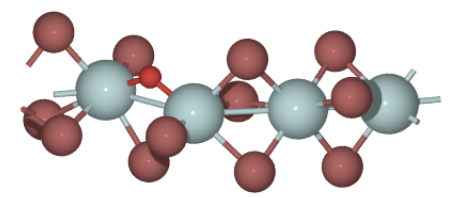
Overview:
This project investigates the chemisorption of hydrogen and oxygen on one-dimensional transition-metal halides (Ti, Zr, Hf) using computational techniques. The goal is to understand how gas atoms bind to these materials and how chemisorption affects their electronic properties, leading to potential applications in creating new compounds with useful chemical properties.
Data Sources:
The materials studied have the formula XY₃, where X is a transition metal (Ti, Zr, Hf) and Y is a halogen (Cl, Br, I). These 1D materials were analyzed computationally to study their surface interactions with gas atoms.
Tools and Technologies Used:
We used density functional theory (DFT) to calculate chemisorption energies, Fermi energy shifts, and electronic changes due to gas adsorption. Additionally, correlations between chemisorption energies and work functions were explored to understand the role of electron transfer in bonding.
Key Findings:
Chemisorption led to a reduction in d-electrons and significant shifts in Fermi energy, altering the electronic properties of the materials. Chemisorption energies correlated with the work functions, underscoring electron transfer's key role. These results suggest potential for developing new compounds with valuable chemical properties through controlled gas adsorption.
Learn More:
For a detailed exploration of this project, including methodologies, detailed results, and implications, please refer to the database and papers.