
Welcome to my data science portfolio
Systematically investigated the properties of 2000 one-dimensional materials using density functional theory (DFT) to explore, model, and predict their structural, thermodynamic, and electronic behavior. Leveraged experimental databases and machine learning to generate novel materials, discovering hundreds of stable 1D structures. This approach uncovered insights into material stability and potential applications in quantum computing, energy conversion, and gas atom binding.
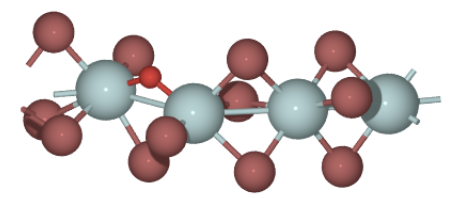
Explored the chemisorption of hydrogen and oxygen on one-dimensional transition-metal halides (Ti, Zr, Hf-based) using computational methods. Investigated materials with a three-fold symmetry structure, examining how gas atoms bind to their surfaces. Found that chemisorption significantly alters the electronic properties, including Fermi energy shifts, and correlates with the work function of the clean systems, highlighting the critical role of electron transfer in the bonding process. These findings open the door to discovering new compounds with valuable chemical properties.
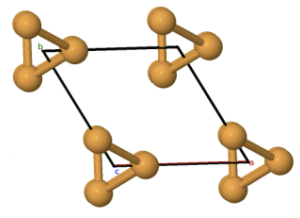
Investigated the light absorption properties of one-dimensional selenium for photovoltaic applications using first-principles calculations. Studied pristine selenium's band gap and optical absorption, along with the impact of intrinsic and extrinsic defects on electronic properties. Found that while intrinsic vacancies have minimal effects on performance, extrinsic defects introduce deep levels that increase non-radiative recombination, limiting efficiency. These insights suggest optimizing synthesis conditions to minimize extrinsic impurities can significantly enhance selenium-based solar cells.
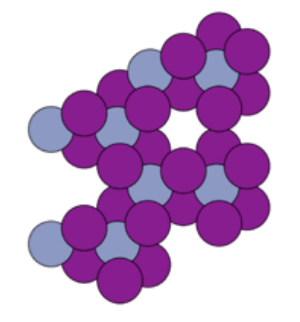
Performed high-throughput computational screening of bulk materials to identify two-dimensional magnetic compounds using data from crystal structure databases. Applied a geometric descriptor to select exfoliable materials, discovering 85 ferromagnetic and 61 antiferromagnetic candidates. Calculated magnetic exchange, anisotropy parameters, and Curie temperatures using density functional theory, with results aligning well with known 2D ferromagnets. Identified 10 new potentially exfoliable ferromagnets and 18 antiferromagnetic insulators with strong exchange coupling, opening new avenues for magnetic material applications.
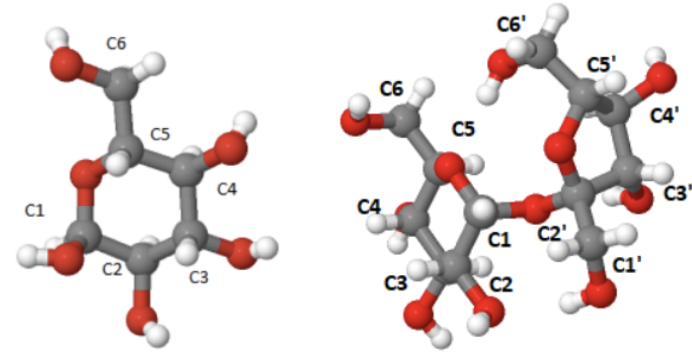
Explore the 13C NMR chemical shifts of saccharides in the solid state using density functional theory (DFT). By modeling mono-, di-, and trisaccharides, I analyzed how glycosidic linkages and crystal water affect NMR shifts. The study revealed significant chemical shift changes at glycosidic linkage atoms and nearby atoms influenced by crystal water. These findings provide valuable insights into the structural factors affecting NMR signals in saccharides, paving the way for further research into spin-spin coupling and other NMR properties.
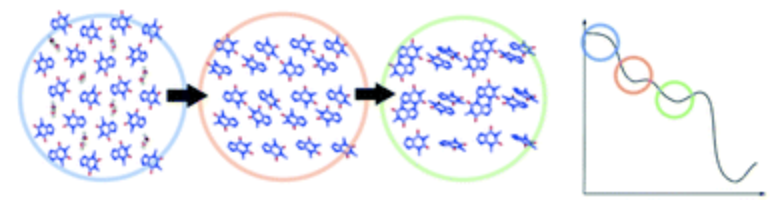
Explored the dehydration phase transition of theophylline using molecular dynamics simulations. Combined theoretical and experimental techniques, including PXRD and solid-state NMR, to identify short-lived metastable crystal phases. Found that these high-energy forms play a critical role in the phase transition mechanism, with water channel closure and molecular reorganization driving the transformation. The study highlights the significance of metastable phases, often overlooked in traditional experimental approaches.