
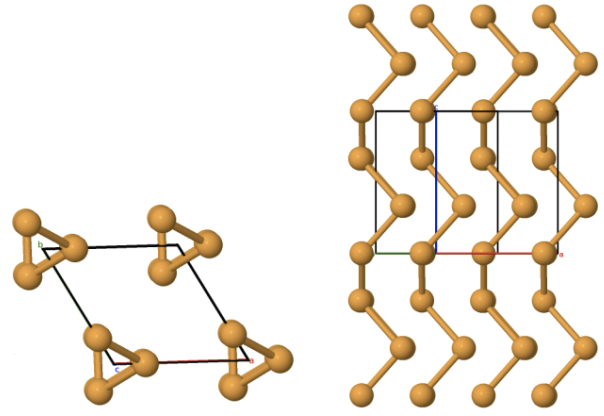
Overview:
This project investigates the light absorption properties of one-dimensional selenium for photovoltaic applications. We focus on how defects—both intrinsic and extrinsic—affect its electronic properties and photovoltaic efficiency.
Data Sources:
The study is based on first-principles calculations of pristine trigonal selenium, exploring its band gap, optical absorption, and defect-related recombination behavior.
Tools and Technologies Used:
We used many-body perturbation theory (GW and BSE) for electronic property calculations and various functionals (PBE, HSE06, SCAN) to study defect formation energies and doping effects on selenium.
Key Findings:
Pristine selenium shows excellent agreement with experimental band gaps and optical absorption. While intrinsic defects have minimal impact on efficiency, extrinsic defects introduce deep levels that cause significant non-radiative recombination, reducing photovoltaic performance. These findings suggest improving synthesis conditions to limit extrinsic impurities can enhance selenium-based solar cell efficiency.
Learn More:
For a detailed exploration of this project, including methodologies, detailed results, and implications, please refer to the first paper and second paper.